CELLULOSE WOOL: EXCELLENT INSULATION FROM RENEWABLE RAW MATERIALS
On our website, you will learn everything about cellulose wool: economical, efficient, and environmentally friendly thermal and acoustic insulation.
Cellulose wool is a highly effective insulator that protects against extreme temperature changes and ensures comfortable living conditions in both summer and winter. Due to its technical properties, cellulose wool has a significantly longer phase shift than conventional insulation. Cellulose wool, made from 90% recycled waste paper fibers, is installed in unused attics and in sloping ceilings, walls, and floors using the blow-in method.
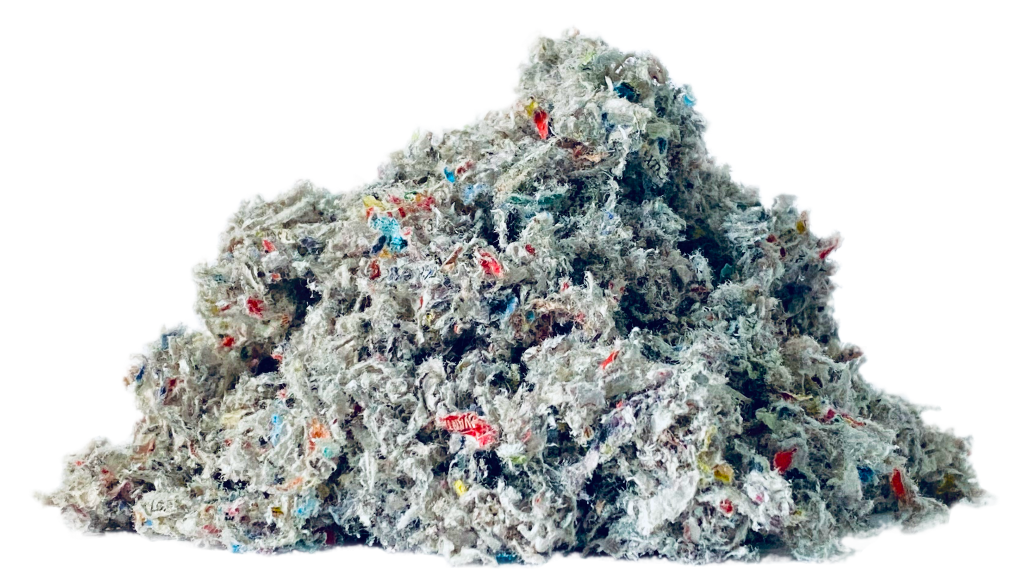
Cellulose wool—what is it?
Cellulose wool is a material made from renewable raw materials used for insulating and soundproofing buildings. Our product is made from waste paper and cardboard. Its natural properties mean that, overall, it achieves significantly better results in terms of energy efficiency compared to traditional insulation materials such as glass wool.
Almost 3 times longer phase shift.
Time required for heat to penetrate blown insulation in an unheated attic for a U-value of 0.15 m²/K.W:
Efficient insulation.
One degree Celsius recovered equals a 7% saving on heating!
HOW TO SAVE ON HEATING?
Thanks to its unique thermal properties, cellulose wool offers significantly greater energy savings compared to mineral insulation. The specific properties and intertwining of cellulose fibers make "cellulose" very effective in combating convection (1). It fills the smallest gaps and has high resistance to air flow, thus significantly reducing convection in the insulation layer.
(1) Convection: air circulation in the insulation layer caused by thermal contrast. This phenomenon involves hot air rising and cold air sinking, which can reduce the actual insulation performance by up to four times compared to laboratory conditions.
COMBAT HEAT LOSS
Attics are responsible for the largest part of heat loss in a house. Depending on the structure and condition of the building, the percentage of heat loss through attics ranges from 30 to 35%.
LIFESPAN
Unlike other insulation materials, cellulose wool, thanks to its natural properties, has no lifespan limit and does not degrade over time. Its durability is equal to that of your home, as evidenced by buildings insulated in Canada for over 50 years.

Effective insulation.
Igloo blown-in or blown-in cellulose wool is designed for use as insulation inside buildings. Our product acts as a shield, reducing the transfer of heat and cold.
AIR TIGHTNESS
Due to the way the fibers are woven, cellulose wool is naturally airtight. During application, our wool fills all gaps that could allow air to pass through, which also guarantees the elimination of convection in the insulation layer.
WARM IN WINTER, COOL IN SUMMER
Due to its density and heat capacity, cellulose wool has a phase shift time (2) that is up to three times longer than that of blown-in mineral insulation, ensuring thermal comfort in summer and reduced energy consumption in winter.
(2) phase shift: the time required for heat or cold to pass through the thickness of the insulation.
ELIMINATE THERMAL BRIDGES
The blowing method allows every cavity to be filled, especially where it is not possible to install traditional "roll" insulation.
DID YOU KNOW THAT?
As early as 1990, the University of Colorado compared two identically constructed houses, one insulated with cellulose wool and the other with glass wool.
The study showed that cellulose wool provides 26.4% more savings compared to glass wool.
From a practical point of view, the temperature in a house insulated with glass wool turned out to be 4°C higher after 9 hours without heating.
A GESTURE FOR THE PLANET
RECYCLING TONS OF PAPER SAVES:
- 3 cubic meters of waste
- 4,000 kWh of energy
- 29,000 liters of water
- 30 kg of CO2
Eco-friendly insulation.
GREEN SOLUTION
Cellulose wool in the production process uses 12 times less energy than conventional insulation materials. Igloo is a "green" solution for your family.
Insulating your home with environmentally friendly Igloo cellulose wool will allow you to save on heating and air conditioning costs.
Canadian statistics:
The North American Cellulose Insulation Manufacturers Association (CIMA) reports that insulating a 150 m² house with cellulose wool allows for the recycling of the paper consumed by a single person over 40 years. If all new homes and buildings were insulated with cellulose, 3.2 million tons of waste paper could be recycled annually.
Sound insulation.
SOLUTION FOR ACOUSTIC INSULATION
Igloo cellulose wool acts as a natural barrier to noise propagation.
Since noise is mainly transmitted through the air, the unique intertwining of cellulose fibers and their porosity significantly reduce sound transmission.

DOES CELLULOSE WOOL HAVE A SHELF LIFE?
THOUSANDS OF WELL-INSULATED HOMES IN NORTH AMERICA AND EUROPE FOR OVER 50 YEARS
In general terms, if we are to believe our Canadian friends, we can say that cellulose wool has unlimited durability and does not deteriorate over time. This is confirmed by data from studies of homes built in Canada in 1920, which already contained cellulose wool at that time.
INSTALLATION QUALITY GUARANTEES EFFECTIVE INSULATION
The durability of cellulose wool also depends largely on several important factors. First, the quality of attic insulation is directly related to the density of the insulation. The minimum density for open blowing is 24 kg/m3, and for blowing in, it is 42 kg/m3, explains Charles Kirie, CEO of Igloo France Cellulose. "The quality of installation is a key factor in ensuring its durability. For this reason, we do not sell directly to the general public, but only to selected and certified specialists." Well-installed wool is a guarantee of effective insulation. "Because safety is our priority," says Kirie, "the installation of Igloo cellulose wool is carried out by professionals trained by our company. Installers are trained in various application techniques (blowing, blowing, and insulation repairs).
Our network of installers meets the demand for installation services in our customers' homes.
HUMIDITY CONTROL
Like all materials made from renewable raw materials and unlike mineral fibers, cellulose wool regulates humidity thanks to its hygroscopic properties: it absorbs excess moisture, retains it, and returns it when the atmosphere becomes drier. Thanks to its long fibers and loose consistency, cellulose wool is ideal for filling the smallest gaps and eliminating thermal bridges in insulation. By regulating humidity, cellulose wool also prevents the growth of fungi, bacteria, and mold. Due to its densely tangled fibers and the presence of boron salts, cellulose wool is largely unfavorable for rodents.
WOOL THAT ALSO WORKS IN WOODEN HOUSES
A HOUSE MADE OF WOOD AND CELLULOSE WOOL – WHEN NATURAL MATERIALS MEET
Eco-friendly cellulose fiber insulation and timber construction are a natural combination. User-friendly wood is known for its thermal and acoustic properties. Like cellulose wool, timber houses have many environmental advantages. A timber house is a dry and clean construction, and the process of building it does not require the use of water. Trees live and breathe—and they help us breathe too. The combination of wood and cellulose fiber is an ideal combination that meets the latest environmental standards.
So, a wooden house is a good solution in terms of environmental protection. Cellulose wool consists of 90% recycled paper. Its production requires 12 times less energy than conventional insulation materials and, equally importantly, the production process does not require the use of water. Needless to say, the combination of cellulose wool and a wooden frame structure works perfectly.
Thanks to its high phase shift, cellulose wool significantly helps to keep heat outside wooden buildings in summer and inside in winter.
FAST CONSTRUCTION - MORE TIME FOR LIFE!
While it takes over a year to build a traditional concrete house, a wooden house can be ready for occupancy in less than six months. This is because traditional construction requires a little more time for the building to dry out, which affects the finishing process. Wooden houses are built using "dry" technology, which avoids excessively long waiting times.
The speed of installing cellulose wool, whether in walls or flat roofs, is ideal for meeting the time constraints imposed by tight schedules. As a rule, 50% of frame houses are prefabricated in the production hall. When the house components arrive at the construction site, they are already insulated, and all that remains to be done is to assemble them properly.
An Igloo-certified installer installs cellulose wool in the walls of a frame house using a specialized machine for blowing in insulation. For a house with an area of 100 m², the installation of cellulose wool takes an average of one to two days.
TO KEEP GOING.
Applications.
insulation is a versatile insulation material, suitable for insulating attics, walls, and floors, both in new buildings and during renovations.
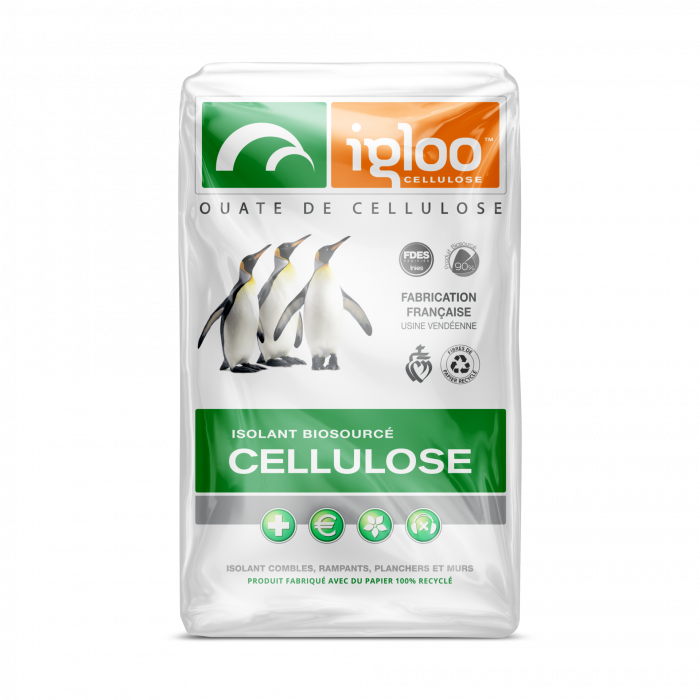
Implementation.
Bulk cellulose wadding can be blown into attics, lofts, roofs, and floors, and wet sprayed onto walls.
Request a quote.
Are you a professional and would like to receive a quote for the delivery of Igloo cellulose wadding?
Find an applicator.
Are you a private individual and would like to contact one of our certified partners?