Igloo cellulose wool – your ally on the construction site
In the prefabrication process prefabrication , not all materials are compatible with each other. They must be adapted to increasing automation, environmental requirements, and strong logistical and economic constraints. Igloo cellulose wool is an insulation suitable for meeting these challenges, offering a unique combination of performance, rational handling, and ease of integration.
Special requirements applicable to prefabrication
Compatibility with prefabrication
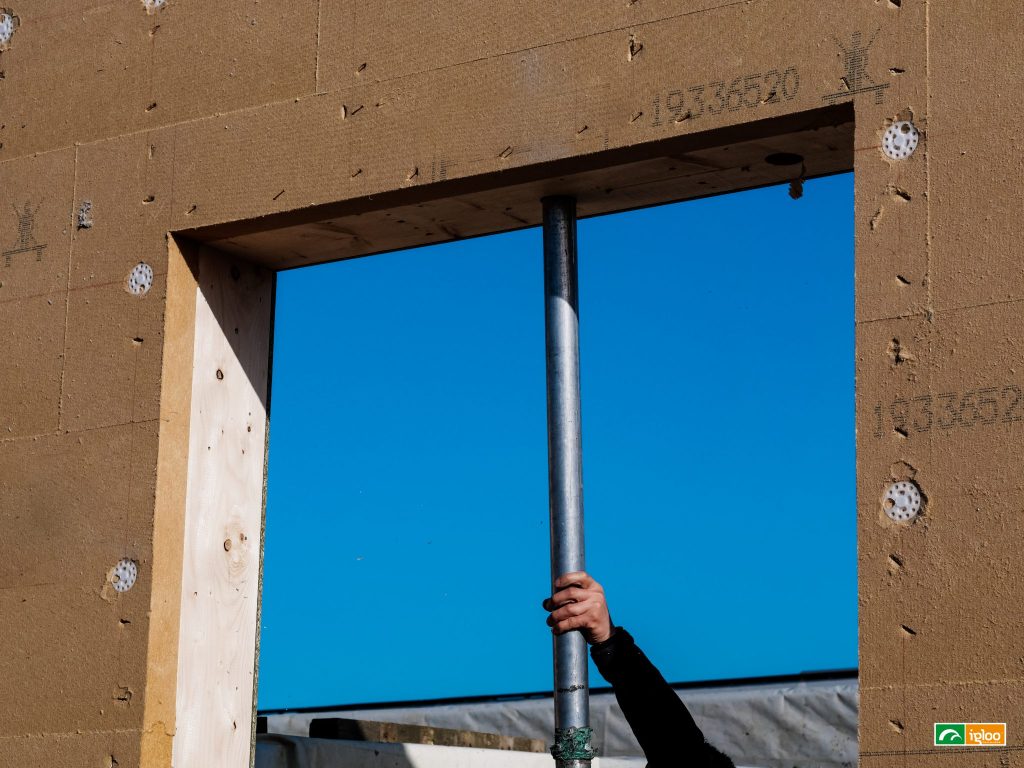
Prefabrication is based on the preparation of elements that are assembled into a building after being delivered to the construction site. The efficiency of the building materials used must be ensured by:
- proper storage and processing under industrial conditions,
- installation in a repeatable, professional, and reliable manner,
- ensuring stable quality regardless of the operator or weather conditions.
The manufacturer of ITS frame houses emphasizes the value of using standardized industrial materials to reduce differences in parameters between the construction site and the design.
Performance and reliability over time
In a situation where the latest environmental regulations require improved energy efficiency and consistency between design specifications and actual performance, the thermal stability of insulation materials is crucial.
Why is cellulose wool particularly suitable for use in prefabrication?
Loose-fill insulation that adapts to the size of the partition
Unlike rigid panels or rolls, cellulose wool is suitable for blow-in applications, allowing it to conform precisely to the shape of the walls—without cutting or material waste. This feature of our material is particularly useful in prefabricated walls, floors, or attics.
Continuity of insulation and reduction of thermal bridges
Research conducted by the French Institute for Building Technology CSTB show that the uniformity of insulation and the absence of empty or poorly filled areas is extremely important for meeting environmental and normative (laboratory) thermal calculations.
Compatibility with prefabrication technology
Prefabricated elements can be composed of various components (wooden frame, glued laminated timber modules, sandwich panels, etc.). Cellulose wool ensures effective implementation at the prefabrication stage without compromising performance.
A well-thought-out solution for professionals
One product for many applications
Igloo cellulose wool can be used for prefabricated walls, floors, and roofing, simplifying procurement, inventory management, and internal logistics for prefabricated components.
Optimized logistics, warehousing, and transportation
Thanks to its compressed packaging, Igloo cellulose wool takes up less storage space, which in turn reduces:
- transport rotation
- logistics costs,
- amount of necessary storage space.
Zero insulation waste
Unlike panels or rolls that require cutting and fitting, cellulose wool adapts perfectly to the geometry of prefabricated elements.
French government agency ADEME also promotes waste reduction as a factor influencing environmental efficiency and the circular economy.
Thermal efficiency and regulatory compliance
Thermal characteristics and phase shift
In addition, cellulose wool has a favorable phase shift , ensuring greater comfort in summer and slower heat release compared to relatively light mineral insulation materials. This advantage also makes it easier to meet the requirements of new environmental regulations.
Compliance with environmental requirements
In combination with prefabrication, cellulose wool enables the required level of thermal insulation, continuity of the coating, and compliance with increasing environmental requirements to be achieved.
Economic and operational gains in prefabrication
Shortening construction time
Installing insulation during the prefabrication stage avoids long and complicated operations on the construction site. At the same time, it also reduces the number of tasks performed, purchasing relationships, and the risk of delays related to execution errors.
Reduction of indirect costs
By minimizing rework, errors, and waste, Igloo cellulose wool helps control indirect and difficult-to-calculate costs that are nevertheless very significant in the construction process (unloading, waste, supervision, etc.).
Sample applications and compatible designs
Igloo cellulose wool is suitable for many types of prefabrication projects:
- Multi-family housing: insulation of prefabricated walls;
- Single-family houses: 2D/3D prefabrication;
- Commercial buildings: increased requirements for thermal and acoustic properties;
Extensions/superstructures: easy integration with prefabricated walls.
Conclusion: cellulose wool is consistent with the logic of prefabrication technology.
Igloo cellulose wool combines the properties necessary to meet the technical, economic, and environmental requirements of modern prefabrication.
Its flexibility of use, thermal efficiency, and compatibility with industrial processes make it a natural ally in ensuring the quality and overall efficiency of projects.
To delve deeper into this topic, check out all the advantages of prefabrication, especially in terms of environmental compliance and the role of insulation in prefabricated construction.
Request a quote.
Are you a professional and would like to receive a quote for the delivery of Igloo cellulose wadding?
Find an applicator.
Are you a private individual and would like to contact one of our certified partners?